Asset Stranding
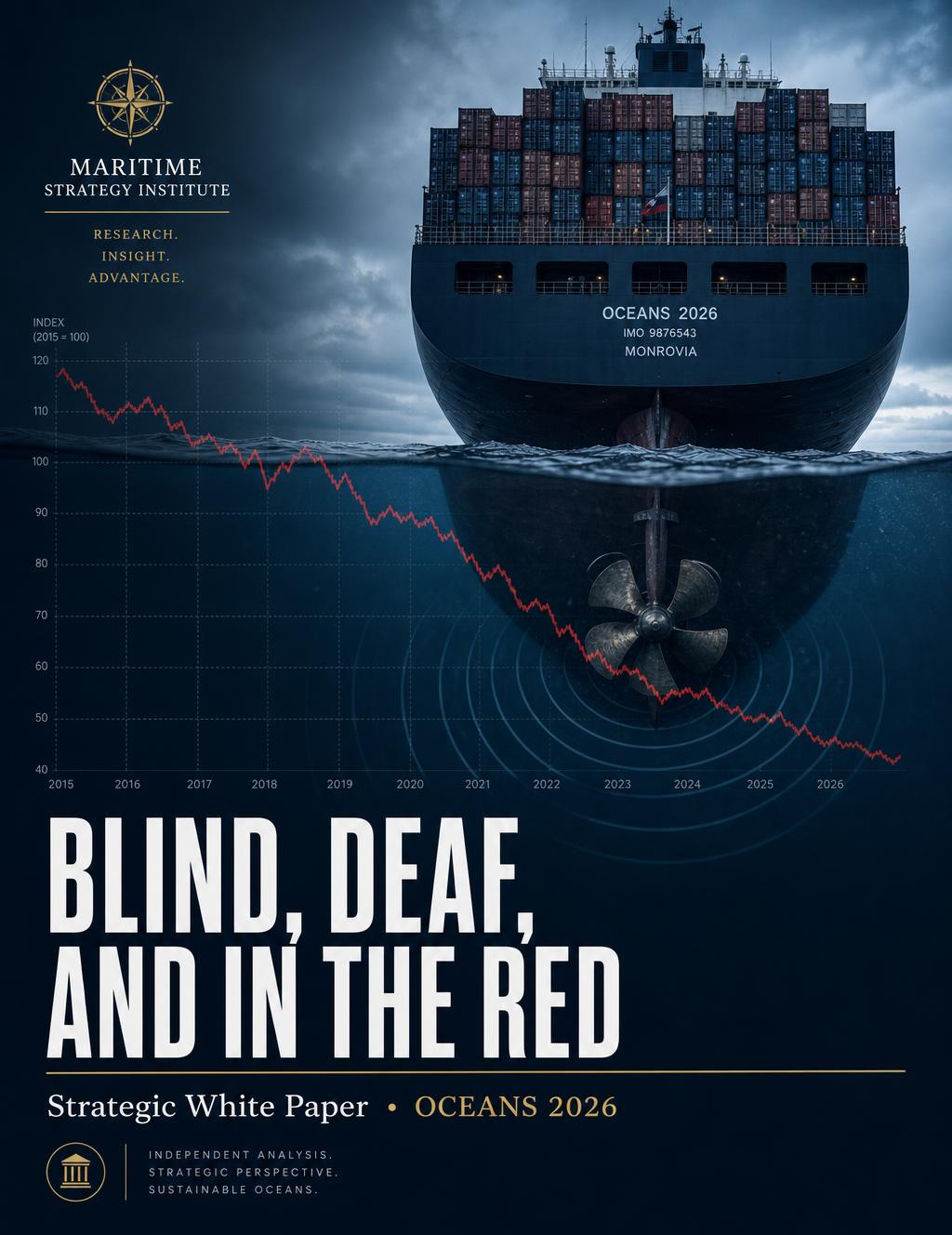
Vessels that fail to meet future noise ceilings face diminished asset valuations and restricted port access, creating significant financial risks for owners.
Acoustic valuation exposure risk
An interactive OCEANS 2026 workshop on underwater radiated noise compliance, fleet strategy, and maritime asset risk.
Administrative notice
Workshop attendance requires a separate conference registration. Expressing interest here helps us plan capacity and simulation role assignments, but does not guarantee a seat without formal OCEANS 2026 registration.
This half-day workshop brings together engineering, operations, policy, and underwriting perspectives to explore how evolving underwater radiated noise requirements may affect commercial fleet planning, compliance strategy, and asset value. Participants will work through a structured simulation designed to test decisions under regulatory, technical, and capital constraints.
Attendee workshop selections are used for planning purposes, and registered attendees may attend any available workshop that day; however, low-interest offerings may be canceled, so early expressions of interest are important.
This session departs from traditional paper-based presentations to deliver a high-fidelity Human-in-the-Loop simulation. Participants will navigate the complex intersections of marine engineering, international maritime policy, and corporate finance.
Instead of treating noise-reduction technologies in isolation, the workshop focuses on the socio-technical system around fleet compliance. It explores how technical verification, market frictions, capital allocation, and policy interpretation interact when organizations must make real decisions under uncertainty.

Lead Organizer • Captain (Ret.), US Navy
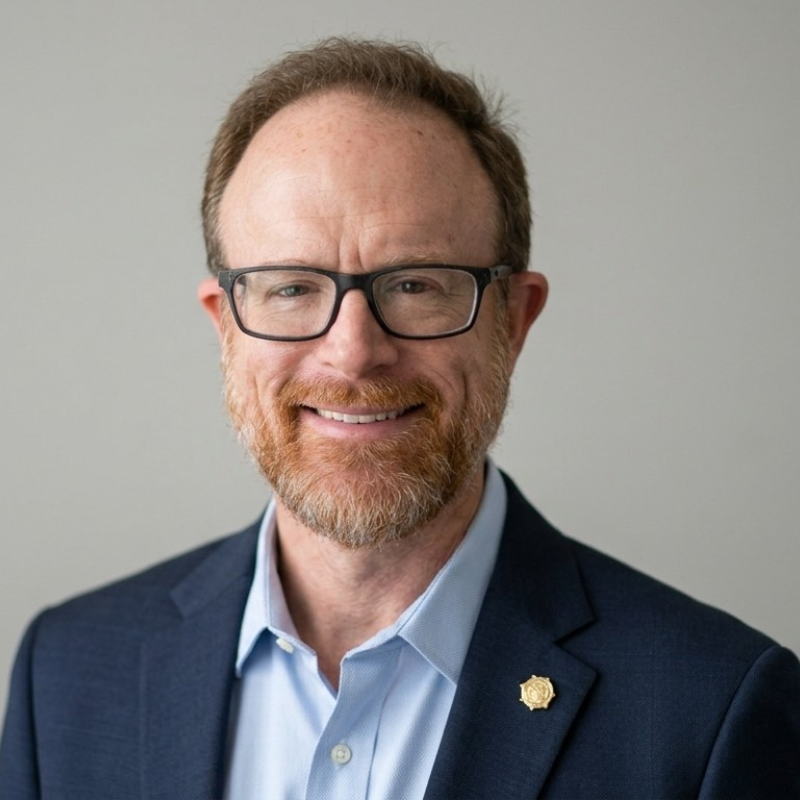
“Retired US Navy Captain and doctoral candidate specializing in URN compliance and its economic impacts on global shipping. My research focuses on bridging the gap between technical acoustic requirements and the practicalities of fleet management.”
High-fidelity hull & machinery sound field dynamics simulated during the workshop.
The regulatory landscape for Underwater Radiated Noise (URN) is evolving rapidly. International frameworks, including IMO MEPC.1/Circ.906/Rev.1, are transitioning from voluntary guidelines toward mandatory compliance.
Vessels that fail to meet future noise ceilings face diminished asset valuations and restricted port access, creating significant financial risks for owners.
Acoustic valuation exposure risk
Long ship lifecycles mean decisions made today will be tested by the legislation of 2030. Modeling this foresight is a critical survival skill.
20–25 year commercial hull horizon
The proposal frames the workshop around a structural regulatory pivot in commercial maritime operations. As URN guidance moves closer to enforceable regional and port-state mandates, non-compliant fleets may face increased operational pressure, compliance costs, and asset-stranding risk.
This makes the issue larger than a purely technical retrofit problem. The workshop is intended to show how engineering evidence, operational constraints, legal interpretation, and underwriting judgment must be considered together if organizations want realistic compliance roadmaps.
IMO guidance under MEPC.1/Circ.906/Rev.1 is moving toward enforceable regional and port-state expectations rather than voluntary recommendation alone.
Speed-power curves, drydock availability, off-hire windows, and route commitments limit what any compliance pathway can realistically deliver.
Uncertainty around future noise thresholds propagates into valuation, debt-service exposure, and lending risk for non-compliant hulls.
2014
First IMO URN guidelines
Voluntary
2023
MEPC.1/Circ.906/Rev.1
Revised guidance
2026
Experience-building phase
Reporting
2030
Simulated regional cap
Workshop scenario · asset horizon
The format
This is not a passive lecture. You will be assigned a role—Regulator, COO, Engineer, or Investor—and forced to make high-stakes decisions as simulation scenarios unfold in real-time.
Explore 4 Simulation RolesThe workshop is built to generate durable research output, not just discussion.
A formal white paper synthesizing engineering pathways, capital friction points, and regulatory timelines.
Decision matrices and risk vectors generated during the simulation, released for future academic and industry analysis.
This is a 3.5-hour, half-day interactive simulation, not a passive lecture session. Participants will be placed into multidisciplinary cohorts and asked to respond to a structured regulatory disruption scenario using a standardized socio-technical decision matrix.
The format is intentionally designed to force interaction between hard engineering constraints and capital asset risk. It includes briefing, scenario injection, constrained decision-making, negotiation, debriefing, and real-time aggregation of results.
Every participant is assigned one of four role dossiers before the session.
Sets and enforces the 2030 regional URN decibel cap under port-state control.
Balances CapEx, charter commitments, and shareholder pressure against compliance deadlines.
Assesses retrofit feasibility, cavitation inception speeds, and wake-field optimization.
Prices asset-stranding risk, debt-service exposure, and valuation of non-compliant hulls.
3.5-Hour Structured Simulation Schedule (Click any row for phase specifics)
The accepted proposal outlines a 210-minute workshop organized around eleven timed blocks.
00:00–00:20
Technical Briefing
Cavitation inception speeds, wake-field optimization, and machinery noise attenuation baselines.
00:20–00:40
Regulatory Matrix
Mapping corporate sustainability mandates and regional port-state noise constraints under MEPC.1/Circ.906/Rev.1.
00:40–00:45
Assumptions Alignment
Shared baseline for measurement, verification, and scenario boundaries.
00:45–01:05
Scenario Injection
Simulated 2030 mandatory regional URN decibel cap and port-state enforcement protocol.
01:05–01:25
Variable Briefing
CapEx, OpEx, drydock off-hire constraints, and fuel-curve penalties.
01:25–01:30
Cohort Allocation
Multidisciplinary cohorts formed and role dossiers distributed.
01:30–02:15
Intra-Cohort Optimization
Cohorts build a compliance roadmap under capital rationing.
02:15–02:30
Cross-Cohort Negotiations
Owners, charterers, regulators, and underwriters negotiate terms.
02:30–03:00
Technical Debriefings
Engineering realism review of each cohort's chosen pathway.
03:00–03:20
Data Aggregation
Real-time capture of decision matrices and risk vectors.
03:20–03:30
Closing Directives
White paper structure and open-access dataset commitments.
Multi-disciplinary cross-sector participation ensures high-fidelity simulation dynamics.
Focus on technical feasibility of noise-quieting technologies.
Help assess source-level reductions, retrofit feasibility, and the engineering realism of potential compliance pathways.
Select for InterestStrategic management of vessel lifecycles and compliance costs.
Bring a practical view of route optimization, speed constraints, maintenance timing, drydock realities, and operating expenditure tradeoffs.
Select for InterestRegulators exploring the industry impact of mandatory URN caps.
Contribute perspective on enforcement variance, policy implementation, and evolving port-state compliance frameworks.
Select for InterestEvaluating asset risk and financial exposure to environmental regulation.
Examine how URN-related uncertainty may affect valuation, debt-service exposure, and lending risk for non-compliant hulls.
Select for InterestFacilitators and panel leaders for the socio-technical simulation sessions.
ConfirmedCaptain (Ret.), US Navy
Lead Simulation Architect
Lead simulation architect and doctoral candidate in Maritime Socio-Technicals. Specialized in submarine acoustics, hydrodynamics, and international maritime environmental policy compliance.
Classification Society Specialist
Classification Society
Under review: Expert speaker on noise class notations, hydrophone measurement array calibration, and sea trial verification protocols.
Commercial Fleet Management
Global Container Lines
Under review: Discussing fleet-wide asset valuation strategies, dual-fuel noise signatures, and commercial roadmap alignment.
Pre-workshop publications, reference materials, and simulation templates.
Academic summary
Full academic abstract outlining the methodology, human-in-the-loop framework, and expected research contribution.
Literature review
Curated bibliography of IMO circulars, hydrodynamics papers, and maritime economics research.
Workshop dossier
Sample simulation role dossier including financial spreadsheet templates and acoustic baselines.
Regulatory standard
Official text summary of IMO MEPC.1/Circ.906/Rev.1 regarding commercial shipping noise reduction.
This page is intended to evolve as the workshop develops: pre-conference materials, in-conference worksheets, and post-conference archival resources.
Pre-conference
In-conference
Post-conference
Add PDF link, repository link, video embed, image gallery, or external archive when available.
We are actively seeking interest from professionals, researchers, and practitioners who want to contribute technical, operational, regulatory, or financial insight to this workshop.
Express interestSpace is strictly limited to 40 participants to ensure high-fidelity role interaction. Complete this form to receive pre-simulation dossiers and updates.

Human-in-the-loop simulation platform
Engineers, fleet directors, and regulators engaging in real-time URN trade-off negotiations.
Everything you need to know about attendance, simulation format, and role assignments.

Session Chair — Student, Sykes College of Business, University of Tampa
Jean-Paul “JP” Dubé is an academic practitioner and retired U.S. Navy Captain with 28 years of service across submarine nuclear propulsion, naval intelligence, and maritime security. His research focuses on environmental regulation, information asymmetry, and underwriting models in commercial maritime URN compliance.
For speaker proposals, technical contributions, media requests, or questions about the simulation, contact the organizer directly.