Back to the workshop

Strategic White Paper | Marine Decarbonization & Capital Markets

Blind, Deaf, and in the Red: How Unseen Propeller Acoustics Impair Commercial Fleet Balance Sheets

Jean-Paul E. Dubé | IEEE/MTS OCEANS 2026 URN Simulation Workshop Chair

Download Complete 15-Page Strategic White Paper (PDF)

PDF | 15 Pages + 2 Reference Pages (17 Total) | APA 7 Rigor | Published 2026

Cover of the strategic white paper Blind, Deaf, and in the Red

Abstract & Executive Summary

Commercial shipping treats underwater radiated noise (URN) as an environmental externality rather than a balance-sheet variable. That framing is a cognitive visibility bias (Bazerman & Moore, 2013): emissions are metered, audited, and priced, while acoustic energy is invisible, unmetered, and therefore assumed to be free. The asymmetry is institutional as much as perceptual — MARPOL Annex VI carries statutory force and enforcement machinery, whereas IMO URN guidance remains a voluntary circular with no penalty regime.

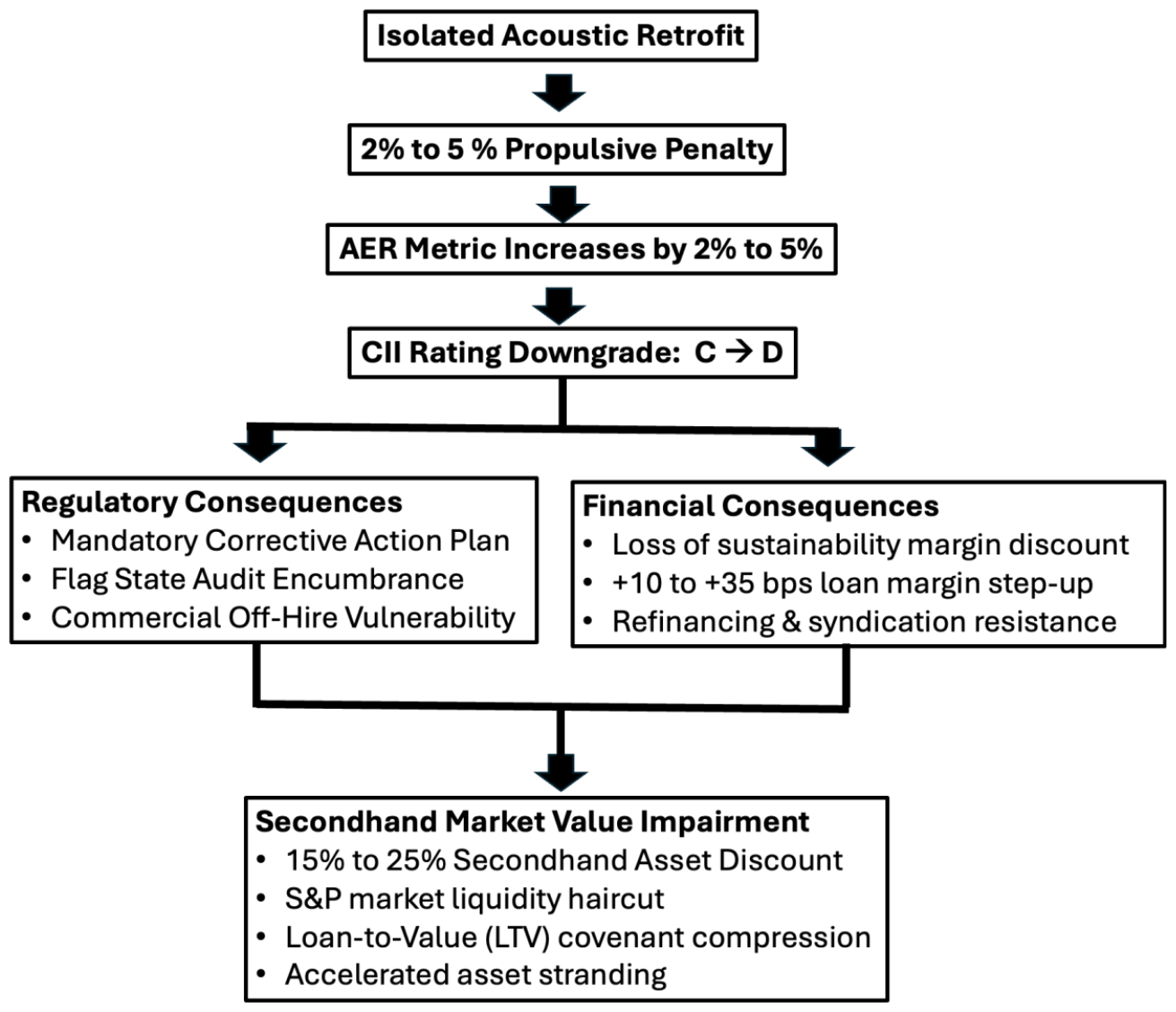
This paper argues that the voluntary framing collapses the moment quieting measures touch the propeller. Blade-tip de-pitching and other cavitation-suppression measures degrade open-water propulsive efficiency, raise fuel burn, and propagate directly into statutory carbon accounting, loan covenants, and charter-party liability. What begins as a hydrodynamic adjustment ends as a repricing of senior debt and a haircut on secondhand asset value.

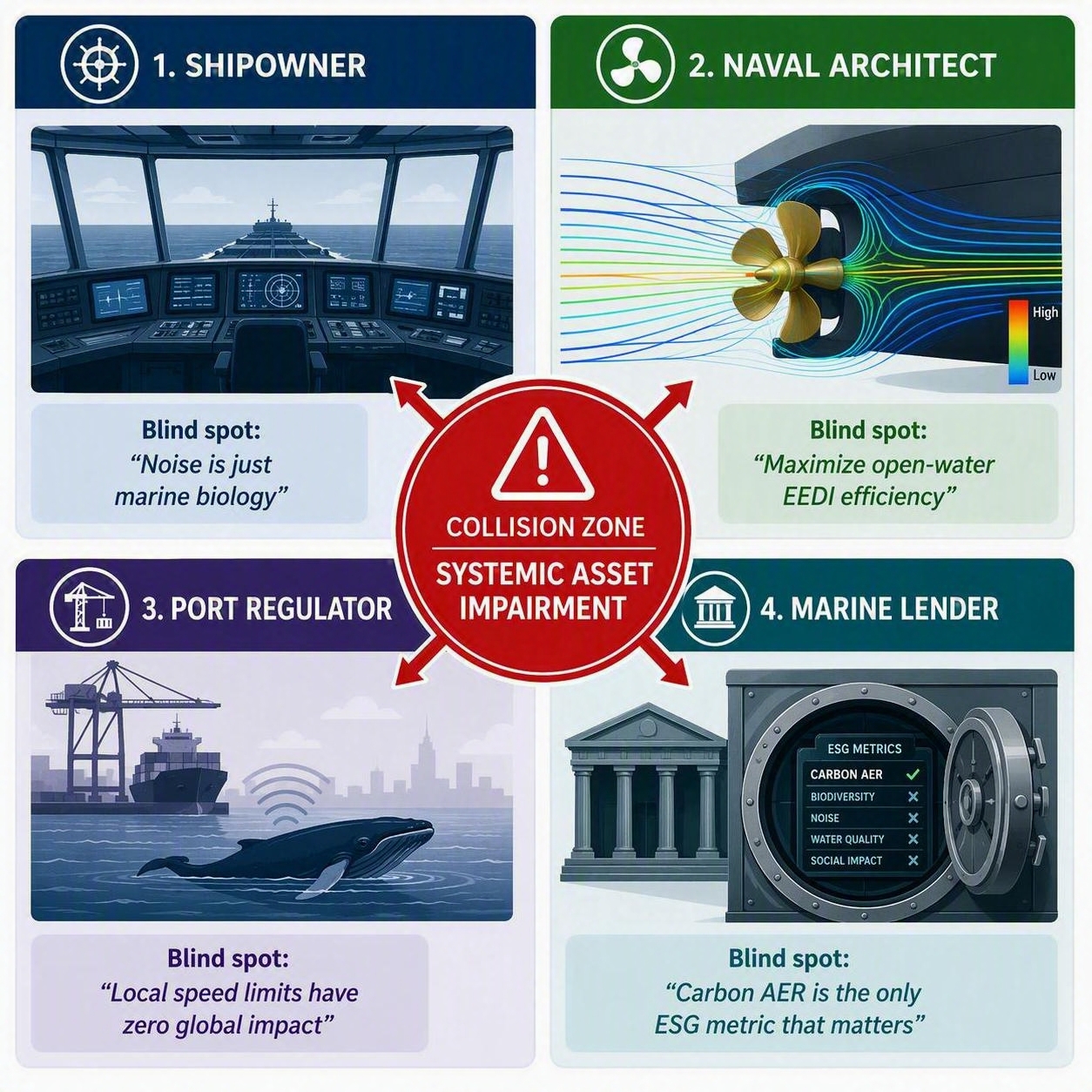
The analysis traces that transmission cascade across four siloed operating models — regulatory, technical, operational, and financial — and shows that they converge on a single, unhedged position: the shipowner's balance sheet.
Key Executive Takeaways

01

The Hydrodynamic Drag Penalty

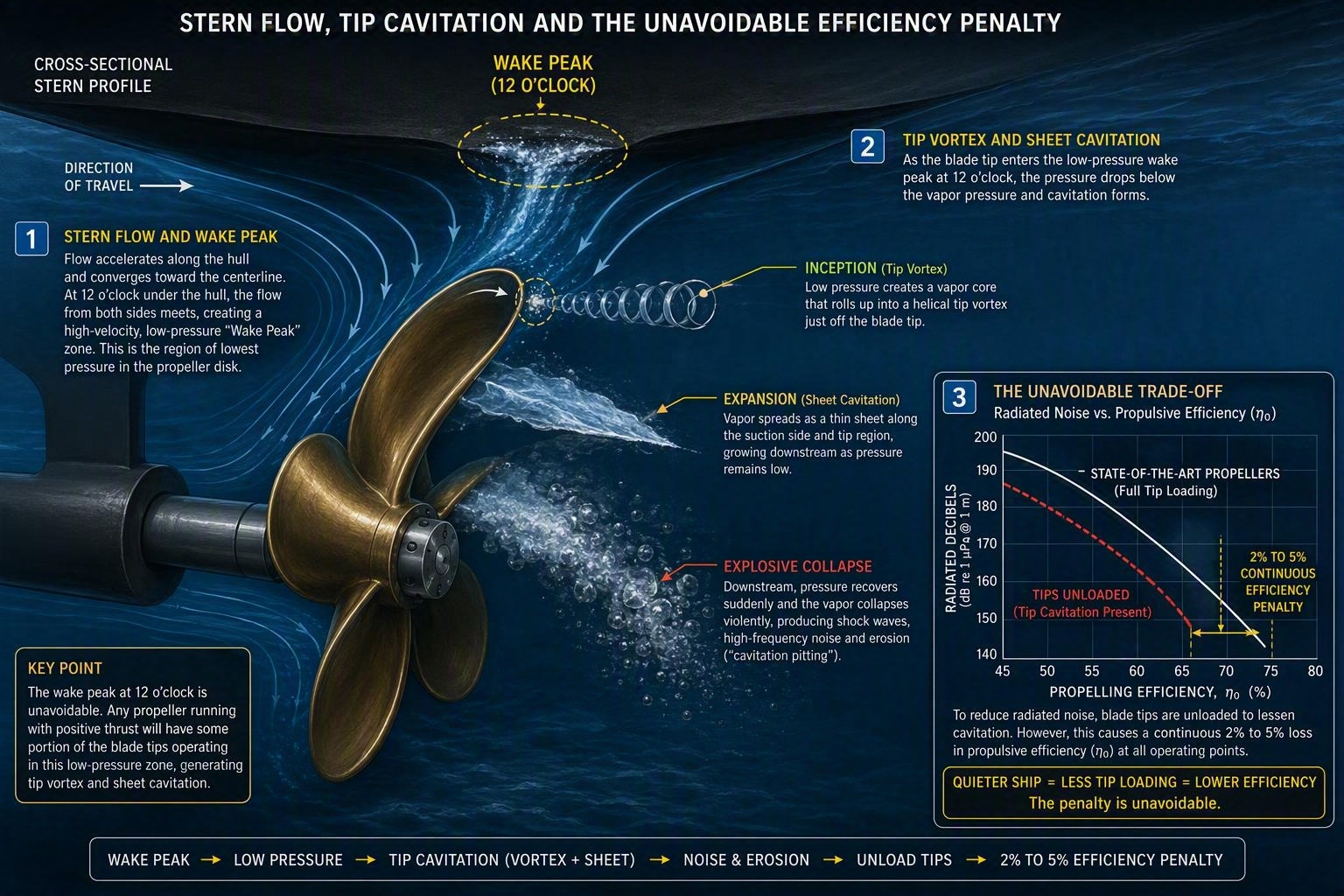
Isolated blade-tip de-pitching imposes an unhedged 2% to 5% open-water propulsive efficiency penalty (η0).

02

Statutory Carbon Downgrades

Fuel increases trigger operational Carbon Intensity Indicator (CII) downgrades from “C” to “D”, forcing mandatory SEEMP Part III remediation.

03

Senior Debt Repricing

Annual Efficiency Ratio (AER) breaches under the Poseidon Principles trip Sustainability-Linked Loan (SLL) covenants, stepping up margins by +10 to +35 bps.

04

Contractual Liability Inversion

Time charterers defend against CII breach claims by citing NYPE Clause 1 and BIMCO Subclause (b), legally shifting excess bunker costs and carbon surcharges back to shipowners as latent defects.

Figures

Figure 1
Figure 1 The Quieting Trade-Off: Stern Flow Non-Homogeneity, Propeller Cavitation Dynamics, and the 2% to 5% Propulsive Penalty.
Figure 2
Figure 2 Capital Structure Transmission Cascade (CII downgrade → SLL ratchet → 15–25% secondhand asset haircut). Download original PDF.
Figure 3
Figure 3 The Cross-Domain Collision: Four Siloed Operating Models Converging on the Shipowner’s Balance Sheet.

Stress-Test These Dynamics Live at IEEE/MTS OCEANS 2026.

Join regulators, operators, naval architects, and ship financiers on September 21, 2026, in Monterey, California, for the Socio-Technical Simulation Workshop.

Register for the Workshop